Keliy Anderson-Staley's practice is diverse, but she is best known for using the wet plate collodion process to shoot tintype and ambrotype portraits and landscape. She is preparing for upcoming exhibitions of her work at Vincennes University, Vincennes, IN and George Bush Intercontinental Airport, Houston. Anderson-Staley is also working on a major public art project with funding from the Houston Arts Alliance and the Cynthia Woods Mitchell Center for the Arts, which will be unveiled in 2018.
We asked her about her commitment to historical photographic processes:
"It's interesting that new art forms don't replace old. There are artists making work in every form of print that has ever been practiced. Artists have always made use of whatever media and tools are available, and I don't think our moment is any different in that regard. The fact that a process is traditional or historic certainly does not mean that artists who use it aren't making relevant or contemporary work. In a lot of cases the history implicit in a particular art form makes it a powerful vehicle for comment on our current culture. And, of course, digital media and "analog" printing methods are not pursued in discrete bubbles - developments in one inform developments in the other. It also amazes me that after centuries of print history and nearly 200 years of photography, so much experimentation and originality is still possible."
Anderson-Staley's work is also notable for how it results in striking objects that are difficult to reproduce. We asked her thoughts on the relationship between image and object.
"I am very interested in conceptual art forms and in works that only exist in digital form, but there is something to be said for engaging with an artwork as a physical object. Whether it is produced by hand or mechanical means, once an image has been printed on paper, it becomes something we can interact with physically - touch (or at least look at its texture), look at it closely or from far away. A print is also an artist's final say on the presentation of an image. Even with a digital image that has been carefully prepared for presentation on a screen, as a viewer, I can adjust brightness or crop it or zoom in or change the way I experience it as a final product."
___________________________________________________________________________
Katherine Ware's work as a curator has included projects that have explored the possibilities of photography in both experimental and traditional ways, often linked to topics of current urgency, for example Earth Now: American Photographers and the Environment, with its accompanying book and website.
We asked Ware to discuss the continued relevance of print in our digital age:
"The fact that we see so many images on a screen now is a big change in the field. One of the issues with that is the inability to see the image precisely as the artist intended or imagined it. The printed image is something that has almost always passed through the artist's hand and been released into the world. I think that is still a tremendously resonant gesture, that even when a press or a printer is involved it is from the hand of the artist to you, the viewer. Phone screens are small enough to be hand-held, but I think it is a different experience, there is a remove to it. So the print, the object, the thing, holds our attention in a different way."
Ware emphasizes the importance of both process and content when she is looking at new work.
"I am deeply interested in how medium and content interact to create meaning in a work of art. The images that excite me -- whether made with one medium or a mix - incorporate materials and techniques in a way that is integral to the overall communication."
Ware's museum, The New Mexico Museum of Art, is one hundred years old this autumn and is planning a big celebration for November 25th, when they will launch three new exhibitions.
"In working on this project, it's been interesting to reflect on New Mexico as a place for innovation and experimentation. I was attracted to come here by the work of artists who work primarily with printmaking and photography but have incorporated elements of other mediums in their work to amplify meaning and expression. That quality is one of the strengths of the museum's collection and we enjoy seeing work that successfully brings together those elements."
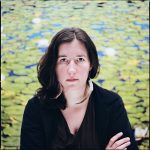 Keliy Anderson-Staley’s work was first introduced to The Print Center through our 84th Annual International Competition. Subsequently, her work has been included in two exhibitions at The Print Center: Stalking the Wild Asparagus (2011) and By the Book: New Photography Publications (2016). Her photographs have also been exhibited at the Akron Museum of Art; Bronx Museum of Art; Ogden Museum of Southern Art, New Orleans; California Museum of Photography, Riverside; and Smithsonian National Portrait Gallery, Washington, DC. Her work is in the collections of Cedar Rapids Museum of Art; Museum of Fine Arts, Houston; Portland Museum of Art, ME; and Library of Congress, Washington, DC. Anderson-Staley book of tintype portraits, On a Wet Bough, was published in 2014 by Waltz Books. She lives in Houston, where she is Assistant Professor of Photography and Digital Media at the University of Houston. She is represented by Catherine Edelman Gallery, Chicago.
 Katherine Ware is Curator of Photography at the New Mexico Museum of Art in Santa Fe, where she has organized exhibitions including the yearlong Focus on Photography series and the exhibition, book and website Earth Now: American Photographers and the Environment. She was invited to serve as curator for Art Photo Index’s inaugural online exhibition and is a frequent juror and reviewer of work by living artists. Ware has written essays on contemporary photographers and is most interested in work that uses mediums inventively and challenges their boundaries.